
Before publication
ClaimCheck Beta
ClaimCheck is for reports that paraphrase their sources rather than quote them. For each cited sentence (a footnote, or a link in the body) it reads the sources that citation gives, cuts out the passages about the sentence, and gives a model's reading of whether they support it. A reviewer starts with the sentences whose sources say less, or something else.
For teams checking a report's paraphrased claims before publication.
What you get
- One row per cited sentence, with its footnote or link, page and cited sources.
- The passages cut from each source that bear on the sentence.
- Two readings and their reasons, with filters for what needs a person.
- A spreadsheet or Markdown file with every source and passage.
What it will not do
- Invent a sentence, a passage or an address.
- Decide whether a source is true, only whether it says what the report says.
- Check a footnote with no address, or an author-date reference list.
- Give a green tick or a red mark: every label is a reading.
How it works
- 1
Upload a report as a PDF or Word file. It cuts out each cited sentence (the words before a footnote marker, or around a link in the body) and the addresses it gives.
- 2
It fetches every cited address and follows a landing page to the document it links; for a link that is dead or blocked it tries the web archive. A footnote with no address is listed with what it cites and is never searched for.
- 3
It reads each source and cuts out the passages that bear on the sentence, word for word. Code looks for each figure in the sentence: in the passages, elsewhere in the text it read, or nowhere.
- 4
It gives a reading of whether the passages support the sentence, partly support it, contradict it, or say nothing on it. The label is a reading, not a finding. A 60-page report takes about 6 minutes; a very long report takes longer. If you leave the page, you get an email when it is done.
Working through a check
-
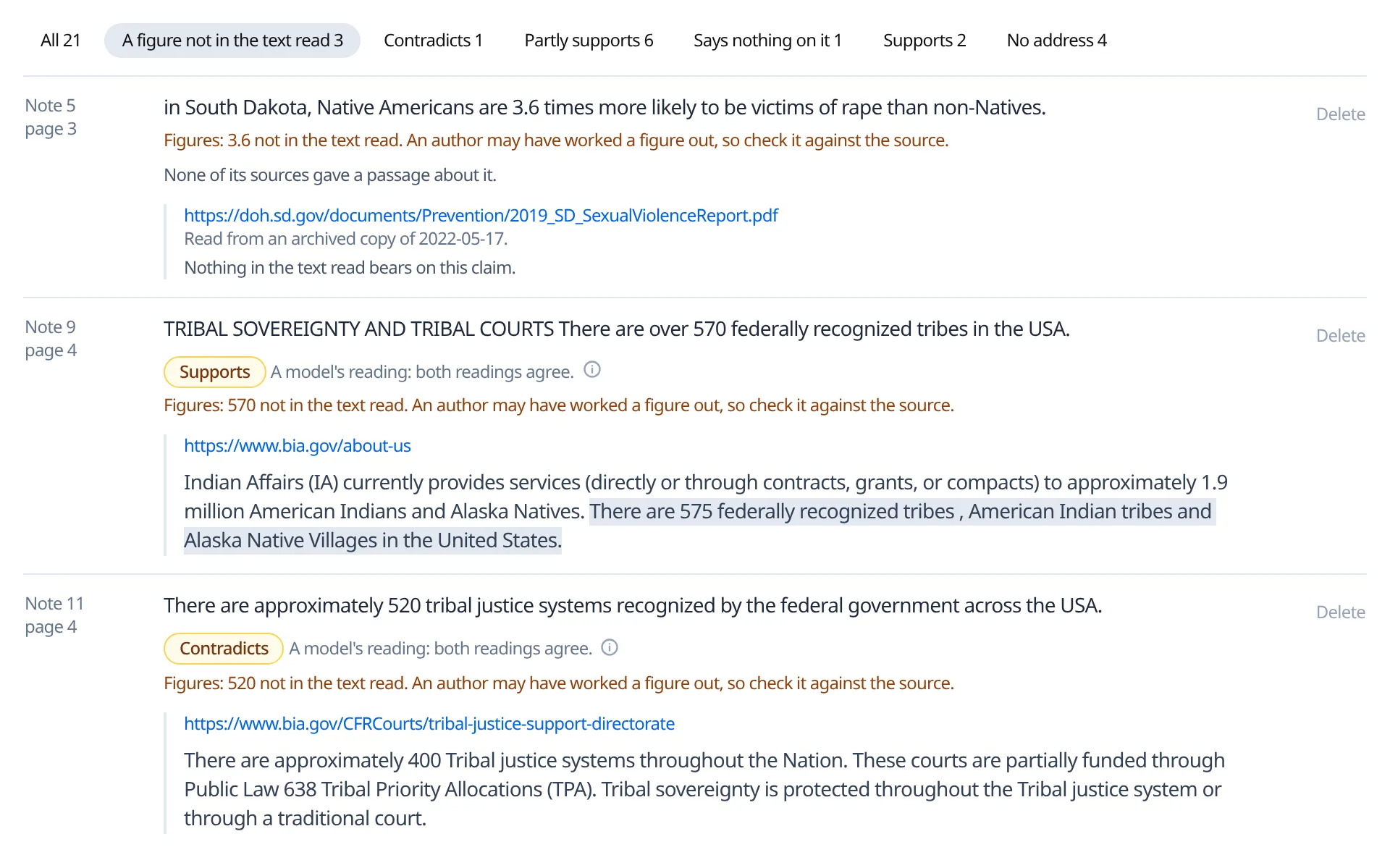
Each row is a sentence with its footnote or link, and its page. Under it come each source's address, the passages cut from it, and where each figure was found. Where a reading says "partly" or "contradicts", the words it found no support for are underlined.
-
Filters pick out what to read first: a figure not in the text read, contradicts, partly supports, readings disagree, says nothing on it, supports, a source not read, and no address. Both readings and their reasons sit behind the info icon.
-
A source it couldn't read says why, and the row counts it as unchecked. A source read with no passage on the sentence says "nothing in the text read bears on this claim", not "doesn't support it": the text may have been a page about the document, or a page in its way.
-
A row can be deleted, and the table downloads as a spreadsheet (CSV) or as Markdown, with every source and passage.
How we keep it honest
It cannot invent a sentence, a passage or a source, by design.
-
Sentences and passages are cut, never typed. Code cuts each sentence from the report. A model points at a passage, and code cuts it from the source's own text.
-
Every address is one the report gives. Sources come only from the links the report gives: in a footnote, in the sentence itself, or, for "Ibid." or "op. cit.", from the earlier footnote it points back to. No model writes an address.
-
A reading has to quote the passages. If a reading points to words that aren't in the passages, it is thrown out.
-
Figures are checked by code, not by a model. "147 is not in the text read" is a fact and is said plainly, but it is never marked as an error, because authors also work figures out (a sum, "a third").
The readings are a model's judgement and are shown that way: no row is ever green or red. The readings can share the same blind spots.
What we measured
We ran ClaimCheck on 18 published reports and planted 274 errors in their claims, each kind a mistake a writer makes: the wrong source, a changed figure, a reversed meaning. Then we ran it once on 16 reports held back until the design was fixed, with 223 errors planted the same way.
0 of 223
Planted errors read as supported, on the held-back reports
17 of 18
“Supports” readings a person agreed with, of 18 claims read whole
0 of 13,714
Passages that differ from the source text
On the held-back reports, code flagged 61 of the 64 changed figures that had passages. Full method and samples are available on request.
Limits
Not a fact-checker of the outside world
It reads what the cited source says, not whether it's true. A sentence fully backed by an unreliable source reads as supported.
Not a finding
Every label is a model's reading of the passages found. Open the source before acting on one, above all before striking a citation.
Not every claim
Footnotes with no address, such as interviews, the organisation's own data or a document named without a link, are listed but not checked.
Not for every citation style
It reads footnotes, endnotes and links in the text. Author-date references with a reference list at the end, as in "(Smith 2020)", are not read.
A stronger claim can still pass
A claim made stronger than its source can still read as supported.
Not inside datasets
A figure cited to a data portal is usually in a table or a download it doesn't read. Such rows say so instead of reporting no passage.
What happens to the report's text
- The report goes to AI providers under zero-retention agreements: they don't keep it or train on it. The sentences and the sources' text go to the models that read them.
- Only the addresses the report gives, in its footnotes and as links in its text, leave the server to fetch the sources, with the document a cited landing page links to. A footnote with no address is never searched for.
- After 30 days the file, its text and every sentence taken from it are deleted automatically, with the readings' reasons. What stays until the check is deleted is the cited addresses, the passages cut from the sources and the label each reading gave.
- The email saying a check is done carries no title, file name or words from the report.
Checking quotations instead? CiteCheck asks whether a quotation's words are in its source.