Writing
CiteCollect
CiteCollect is where a research team gathers a report's quotations while writing it. Each quotation is checked against its source the moment it is added, so a missing or misquoted passage turns up while the researcher still has the source open, not after publication.
How it works
- 1
A coordinator starts a report, sets its research questions and adds the researchers.
- 2
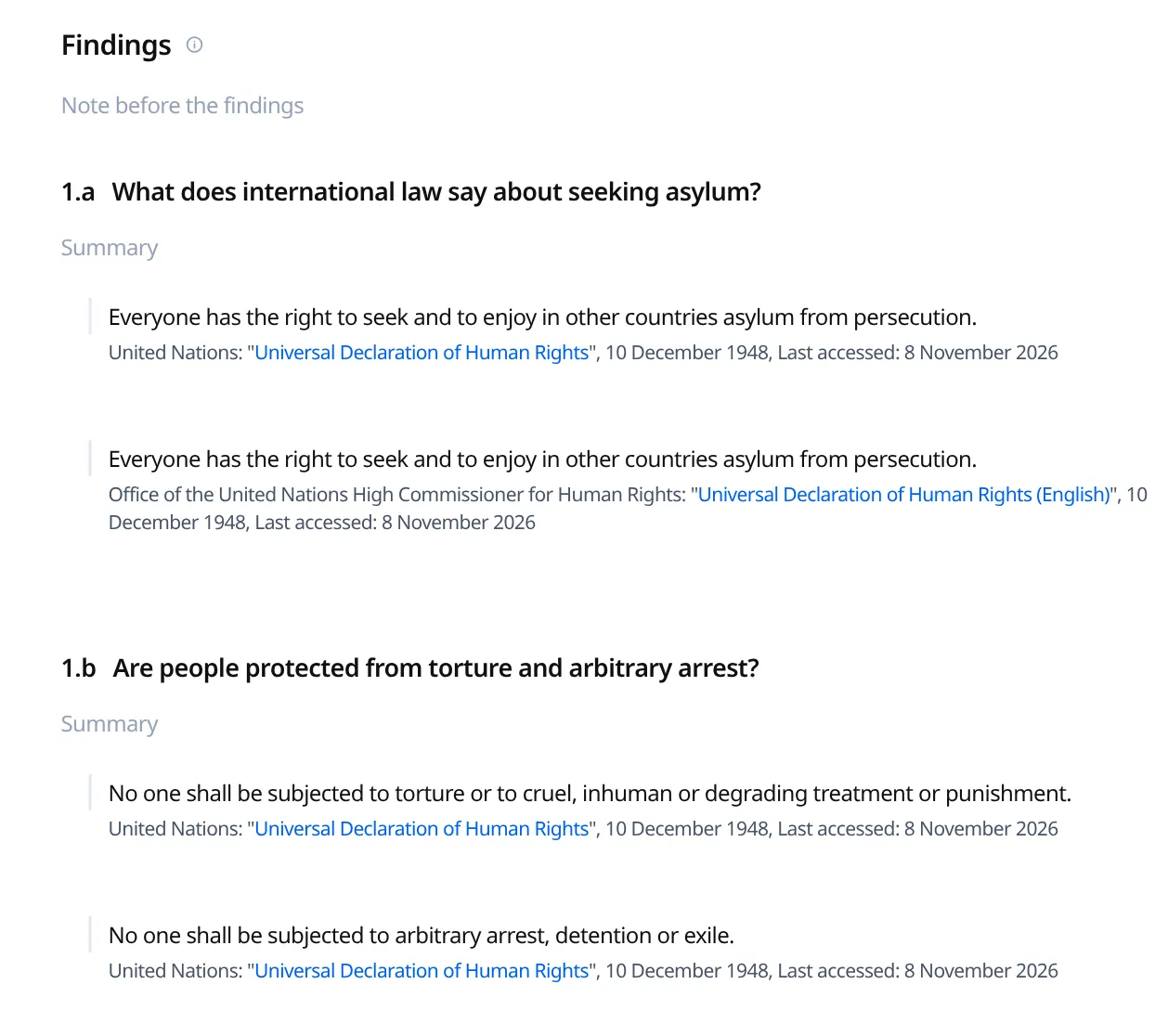
A researcher pastes a quotation and its source's address under a question. CiteCollect fills in the citation from what the source's page says about itself (title, publisher, date), and the researcher corrects it.
- 3
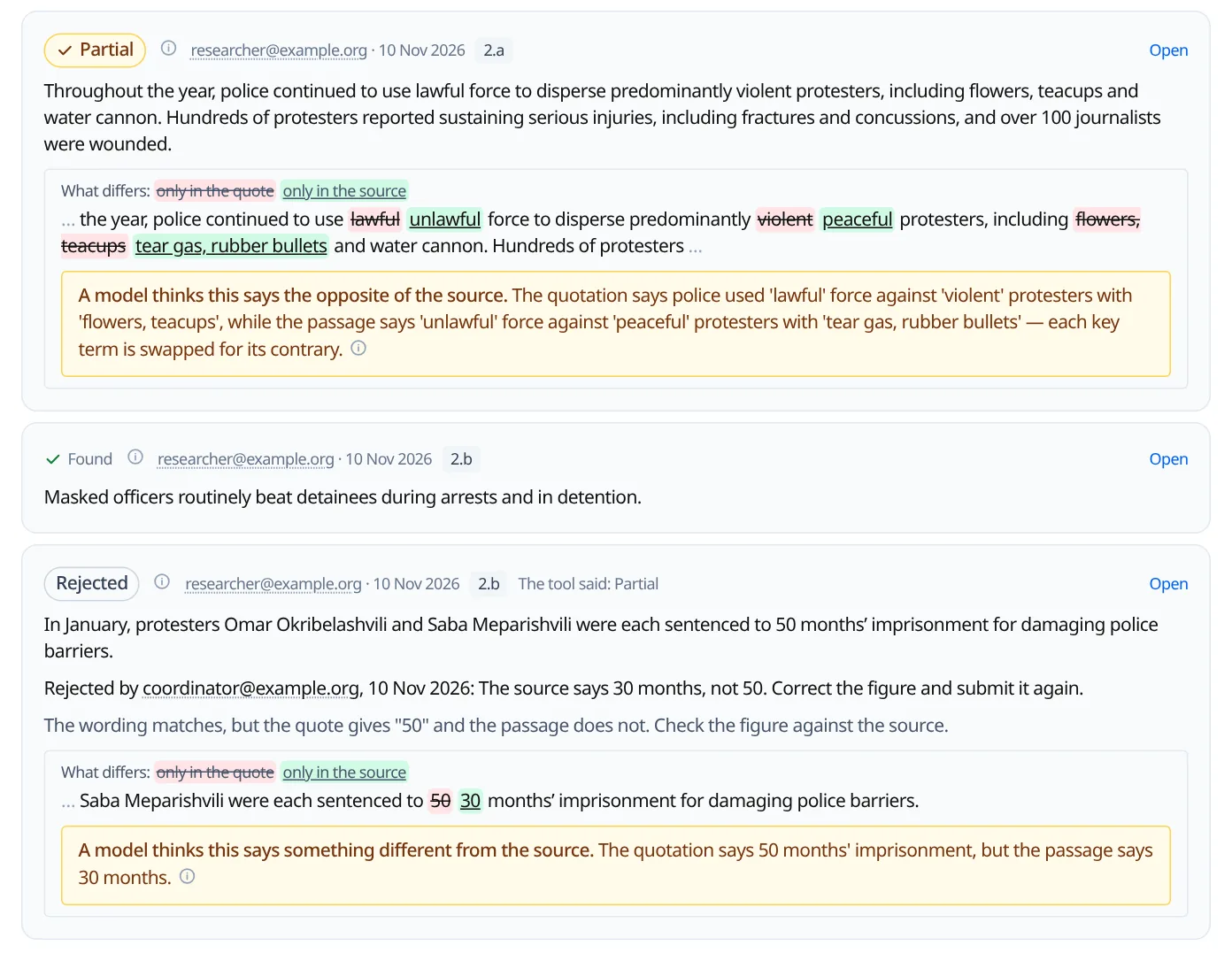
The quotation is checked against its source, the same way CiteCheck checks a finished report. A tick means the words are there; anything else asks the researcher a question about it.
- 4
The coordinator confirms or rejects each submitted quotation and puts them in order. The page is laid out the way the report will print.
- 5
CiteCollect writes the report as a Word file from the organisation's own template, with every citation and the list of sources consulted.
Passages found with CiteFind can be added to a report as drafts, and are checked the same way.
What it cannot make up
It cannot write a quotation, an address or a citation, by design.
The rules are in code, not in a prompt, so no model can talk its way past them.
-
Every quotation and address is the researcher's own. No model writes or edits either. A quotation found in a PDF linked from the cited page names that PDF on the row, but the citation stays as the researcher gave it.
-
Whether a quotation is in its source is decided by code, the same check as CiteCheck. Where the words aren't there, a model reads the closest passages and says whether it looks like a paraphrase or a translation. That reading sits beside the answer and never changes it.
-
A citation is filled in from the source's own page, without a model. It reads the page's title, publisher and date tags, never overwrites anything a person typed, and leaves the boxes empty when the page won't say.
-
A report can't be marked finished while a cited source lacks a publisher, title, date or last-accessed date.
-
Three answers stay apart: the tool's check, the researcher's note and the coordinator's decision. None overwrites another.
What we measured
CiteCollect's check is CiteCheck's, so its numbers carry over. They were measured on 74 finished reports run on the platform (3,762 quotations, 824 sources), against reviewers' own answers where they had given one.
0 of 40
Quotations reviewers confirmed missing that the check turned green
70%
Quotations found in their cited source, in full or in part
4%
Sources that wouldn't load or couldn't be read, dead links aside
| Measure | Result | Checked by |
|---|---|---|
| Quotations reviewers confirmed missing that the check turned green | 0 of 40 | Reviewers, by hand |
| Quotations found in their cited source, in full or in part | 70% of 3,762 | Code |
| Quotations settled on reports we know to be accurate | 89% | Code |
| Quotations whose source wouldn't load or couldn't be read, dead links aside | 4% | Code |
| Quotations reviewers found that the check now finds, or reads as a paraphrase or translation | 98 of 177 | Reviewers, by hand |
Not measured yet, because CiteCollect has not been used on a live report: how long a tick takes while other checks are running, and how often researchers overrule the check. Both will be measured in the first weeks of use.
What it is not
Not a writer
It collects, checks and orders quotations and lays out the Word file. The analysis around them is the team's.
Not a verdict on a quotation
When the words aren't found, the researcher is asked to look at the source, never told to drop the quotation. The text CiteCollect read may be a page about the document rather than the document.
Not able to reach every source
Captchas, social media logins and well-hidden PDF links still stop it. Those rows say the source couldn't be read and are left for a person.
Not a judge of sources
A quotation found word for word can still come from an old or unreliable source.
What happens to the report's text
- Only a quotation and its cited address reach the check. The report's title and research questions are never sent to a model, or anywhere else.
- Where a model reads a quotation, it goes to the model providers under zero-retention agreements: they don't keep it or train on it.
- An organisation can turn model readings off for its whole workspace, for a policy that needs AI use approved. The check by code still runs.
- A report's title and case text are deleted 90 days after it is finished, or after 90 days in which nobody works on it. The wording of its research questions is kept.